
Escala de teste de QI
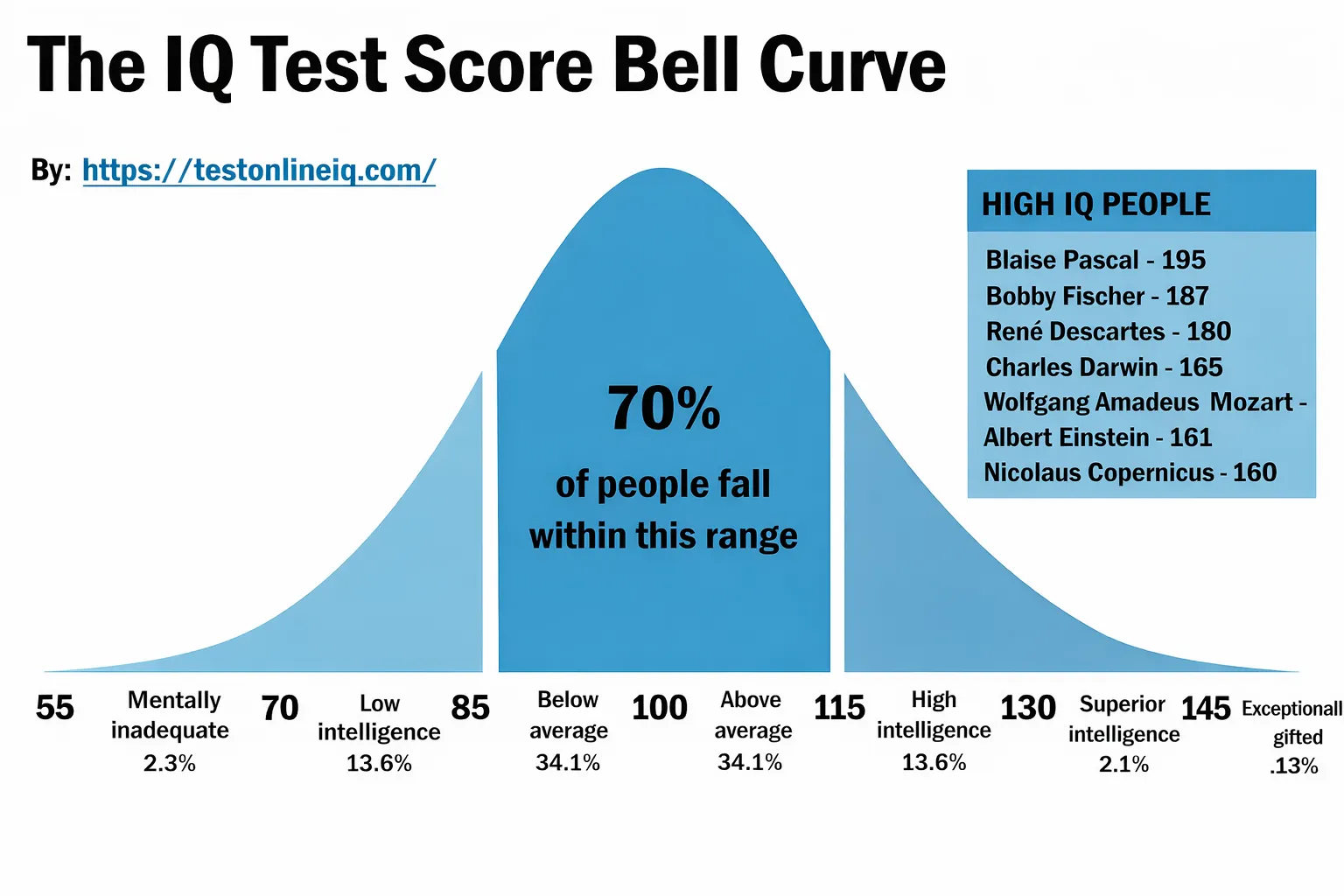
| Intervalo de Inteligência | Designação Cognitiva |
|---|---|
| 40 – 54 | Severamente desafiados (menos de 1% dos participantes do teste) |
| 55 – 69 | Desafiado (2,3% dos participantes do teste) |
| 70 – 84 | Abaixo da média |
| 85 – 114 | Média (68% dos participantes) |
| 115 – 129 | Acima da média |
| 130 – 144 | Superdotados (2,3% dos participantes) |
| 145 – 159 | Gênio (menos de 1% dos participantes do teste) |
| 160 – 175 | Gênio extraordinário |
Qual é a escala de QI?
A escala de Quociente de Inteligência (QI) é um método usado para classificar os níveis de inteligência humana com base em pontuações de testes padronizados. Os testes são projetados para medir diversas habilidades cognitivas, como habilidades verbais, matemáticas e espaciais, bem como memória de trabalho e velocidade de processamento. As pontuações de QI são geralmente calculadas comparando o desempenho de um indivíduo no teste com o de uma amostra grande e representativa de pessoas da mesma idade.
A escala de QI mais comumente usada é baseada em uma distribuição normal (curva em sino) com uma pontuação média (média) de 100 e um desvio padrão de 15. Isso significa que a maioria das pontuações de QI da população está dentro de uma certa faixa em torno da média:
- Abaixo de 70: Deficiência intelectual (cerca de 2,2% da população)
- 70–84: Inteligência abaixo da média (cerca de 13,6% da população)
- 85–114: Inteligência média (cerca de 68% da população)
- 115–129: Inteligência acima da média (cerca de 13,6% da população)
- 130–144: Superdotados (cerca de 2,2% da população)
- 145–159: Altamente superdotados (cerca de 0,3% da população)
- 160 e acima: Excepcionalmente superdotados (menos de 0,1% da população)
É importante observar que as classificações e faixas específicas podem variar ligeiramente dependendo do teste de QI utilizado. Além disso, a escala de QI é apenas uma medida de inteligência e não captura todos os aspectos das habilidades cognitivas, criatividade ou inteligência emocional de uma pessoa.
Perguntas frequentes sobre pontuação de QI
P: Quão estáveis são as pontuações de QI ao longo do tempo?
R: As pontuações de
QI tendem a ser relativamente estáveis ao longo da vida adulta, mas podem flutuar na
infância e na adolescência devido a factores como o desenvolvimento do cérebro,
oportunidades educacionais e experiências de vida.
P: As pontuações de QI são influenciadas pela genética ou pelo ambiente?
R:
Tanto a genética quanto os fatores ambientais contribuem para diferenças individuais na
inteligência. Estudos sugerem que a genética desempenha um papel significativo, mas fatores
ambientais, como qualidade da educação, nutrição e interações sociais, também podem impactar
as habilidades cognitivas de uma pessoa.
P: Quão confiáveis são os testes de QI?
R: Os testes de QI são geralmente
considerados medidas confiáveis e válidas de habilidades cognitivas. No entanto, podem não
captar todos os aspectos da inteligência e os preconceitos culturais podem potencialmente
afectar o desempenho nos testes. É essencial considerar múltiplas fontes de informação ao
avaliar as habilidades cognitivas de alguém.
P: O QI de uma pessoa pode mudar com o tempo?
R: Embora as pontuações de QI
tendam a ser relativamente estáveis ao longo da vida adulta, acontecimentos significativos
na vida, oportunidades educacionais ou problemas de saúde podem levar a alterações nas
capacidades cognitivas. É possível que o QI de uma pessoa mude, mas mudanças significativas
são raras.
P: O QI é a única medida de inteligência?
R: Não, o QI é apenas uma medida de
inteligência e se concentra principalmente nas habilidades cognitivas. Outros aspectos da
inteligência, como a inteligência emocional ou a criatividade, não são totalmente captados
pelos testes de QI tradicionais. É importante considerar múltiplas dimensões da inteligência
ao avaliar as habilidades de uma pessoa.